Horse Galloping On A Tomato
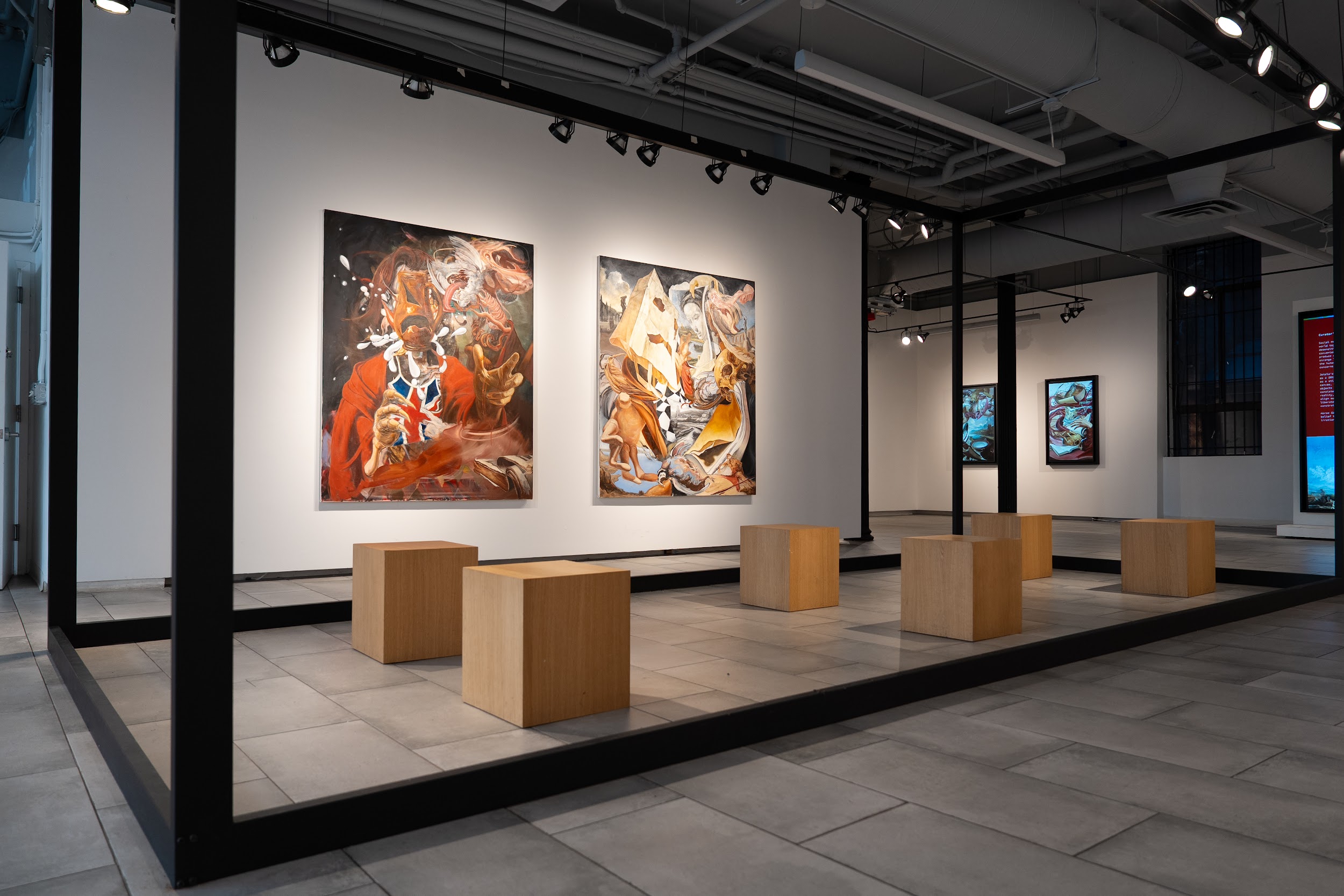
After Paris earlier this year, the Czech artist Tomáš Jetela continues his journey across the Atlantic. You have to go to the Mriya gallery, located at the tip of Manhattan, to discover its new solo exhibition entitled Horse Galloping on a Tomato. A nod to André Breton’s famous phrase,“Any man who can’t picture a horse galloping over a tomato is an idiot.” The title resonates less as a tribute to earlier surrealism than as a foreshadowing of an after surrealism. After what? After that the meaning could emerge from a new state of mind that I would qualify here, for the first time, of “subversionism”. Because the work must, more than ever, subvert the viewer’s expectations. The absurd encounters a form of abundant playfulness that can no longer be contained; a symbol of an era in constant metamorphosis. Art, like the body and history, relentlessly becomes… a museum that risks losing its imagination. Painting resists and Tomáš Jetela is part of those who reinvent the contemporary image as an act of self-defense… an image that cannot be consumed or tamed because it fully embraces confrontation and disruption to survive.
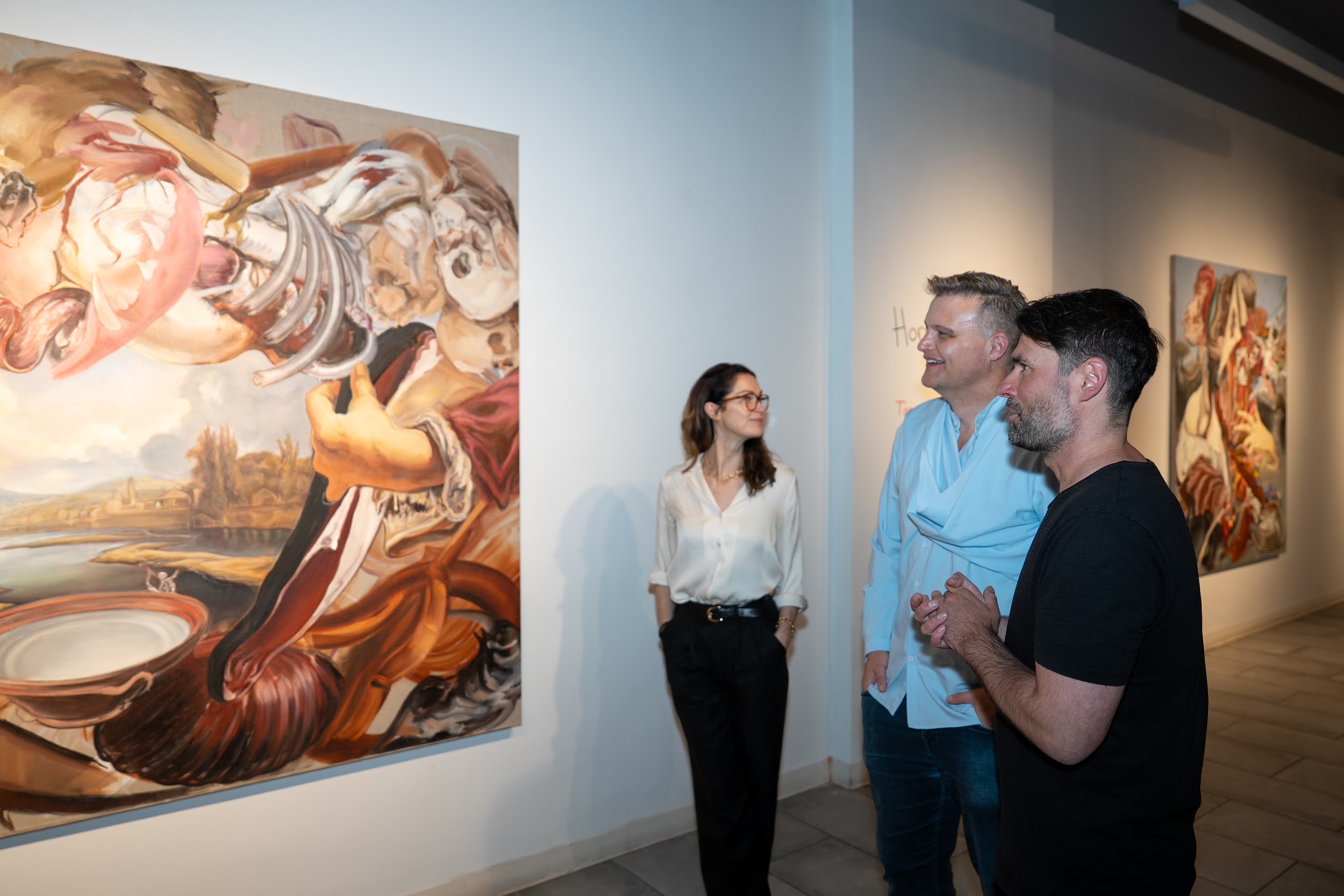
The gallery space allows visitors to wander freely and immersively among these monumental humanities (or rather, inhumanities). The artist challenges our gaze to still be able to “visualize” beyond our capacity to simply “see” or even “receive.” He forces our imagination to “create” with him… to actively and even physically complete him. At the antipodes of artificial intelligence and algorithmic passivity, Tomáš Jetela takes back control of a world on autopilot. Ruthlessly, he pricks us in our vulnerability, our sensitivity, our habits, and our laziness. He challenges us to a duel… right down to the depths of our (overly) predictive (and predictable) brains. To be or not to be an idiot, that is the question? Through this, the artist awakens within us the error we must correct in order to continue to understand the world… like riders triumphing over the everyday and its absurdity. He teaches us to fish in our deep waters to make visible what is not (or no longer) visible. He reveals in each of us what is irrefutable, unpredictable, and often fallible… this unique quality of being human.
Layer upon layer, memory, like the composition of the canvases (mounted on their metal exoskeletons), reveals secrets like an epigenetics of the image. The object still serves as a fragile mask for the subject; personality and identity are concealed behind the reassuring and anonymous materiality of things. But the paper tears, the porcelain shatters, hinting at the pareidolia of perishable faces with theatrical emotions… torn between tragedy and comedy. Tomáš Jetela displays the very moment when the Persona wavers, yet maintains the unbearable suspense that precedes a major revelation. The viewer is in the front row, confronted with this acting as if facing a cursed mirror. Will the social mask fall, or will the figure remain trapped in this story that, ultimately, isn’t truly their own? The challenge is no longer about appearing or pretending, but about being… with the same authenticity as the work of art: wearing a true face.
“I WAS ASHAMED OF MYSELF WHEN I REALIZED THAT LIFE WAS A MASQUERADE BALL AND THAT I WAS THERE WITH MY TRUE FACE.” – FRANZ KAFKA
At the same time as he tries to bring us closer to the breaking point of the Persona, Tomáš Jetela is increasingly exploring contemporary Vanitas. Marginal or incidental references are no longer sufficient. He needed to go beyond the Memento Mori and the skull patiently waiting beside the figure. Already, the figure had become, in his work, a living still life… a vanitas absorbed by its perpetual metamorphosis. Yet, with this exhibition, the artist undertakes an even more pronounced paradigm shift. He now seems to assert that death no longer ends humanity but defines it, in all its splendor, from the very beginning. Mortality withdraws from allegory to finally embrace itself as a component of being in the world. To the limitless dreams and promises of eternity that society imposes on us through marketing or accelerated dehumanization, the artist now seems to respond by celebrating limits and mortality. It becomes an essential quality of humanity… a sublime condition for existential enjoyment. Anti-hero or true superhero… the conscious mortal (and happy to be so) becomes the new ideal of an era grappling with performance and a certain crisis of the beholder; this spectator who is more often asked to see what we want to show him rather than to visualize what is most precious and sacred within him.